
No products in the cart.

BUY
NOW
Reports
Directions
NuronBioSafe controls a wide range of diseases on fruit, vegetables and ornamentals. An easy to use, broad-spectrum formula


Sumifru Fusarium Oxysporum report

November 14, 2012
The pallets from PP300 were subjected for Microbial evaluation due to the occuring problem of the pallet infested with molds and the need of appropriate and correct application of disinfectant. Four phased of Microbial evaluation was conducted to isolate and identify the molds in the pallet from PP300.
The four phases are:
| Phase I | Collection, Isolation and Identification of Molds in Pallet using Swab Method |
| Phase II | Microbiological Assay of Fectant-3 using Serial Dilution Method |
| Phase III | Microbiological Assay using Nuron against the Isolated and Identified Molds in pallet from P300 |
| Phase IV | Actual Preliminary Simulation of Nuron disinfectant in the PP300 Used Pallet |
Four swabs were collected from randomly selected unused and used pallets at PP 300 for Mold isolation and identification.
| Sample Description | Molds Count (cfu/ml) | Identified Molds | |||
| Fusarium sp. (cfu/ml) | Aspergillus sp. (cfu/ml) | Penicillum sp. (cfu/ml) | Rhizopus sp. (cfu/ml) | ||
| PP 300 Unused Pallet | 4.9 x 10� | <10 | <10 | <10 | 4.9 x 10� |
| PP 300 Used Pallet Upper Surface | 2.9 x 10� | 1.0 x 10� | 1.9 x 10� | <10 | <10 |
| PP 300 Used Pallet Lower Surface | 1.4 x 10� | <10 | <10 | 1.4 x 10� | <10 |
| PP 300 Used Pallet Side Surface | 1.0 x 10� | <10 | <10 | <10 | 1.0 x 10� |
Table 1 depicts that there were four isolated and identified Molds from the pallet swabs from PP 300. Only Rhizopus sp. tih a population count of 4.9 x 10� cfu/ml was isolated from the unused pallet. On the other hand, Fusarium sp., Aspergillus sp,. Penicillum sp., and Rhizopus sp. with a population count of 1.0 x 10� cfu/ml, 1.9 x 10� cfu/ml, 1.4 x 10� cfu/ml and 1.0 x 10� cfu/ml, respectively, were isolated from the used pallet swabs.
The four isolated and identified Molds collected from the pallets at PP300 were subjected for Microbial Assay using two disinfectant namely Fectant-3, which was the first option before apprival of Nuron, and Calsium hypochlorite using Serial Dilution Method. Thus, Fectant-3 was compared to such source of chlorine.
Fectant-3 contains 1.60% Dimethly Benezen Ammonium Chloride, 1.60% Dimethyl Ethylbenzil ammonium Chloride, 1.30% Trisodium Phosphate and 1.10% Tetrepotaasium Ethylenediamine Tetracetate labeled as sanitizer, disinfectant and deodorizer. And it is claimed to be good disinfectant for human and plant pathogen as well. Chlorine in a form of calcium hypocholrite (70%) is a common disinfectant used in our operation.
| Treatment | Microbial Assay using Serial Dilution Method (Density of the inoculum is 1.5 x 10�) | ||||
| Fusarium sp. | Aspergillus sp. | Penicillum sp. | Rhizopus sp. | ||
| Fectant-3 | T1 40ml/L | No growth | No growth | No growth | No growth |
| Â | T2 20ml/L | No growth | No growth | No growth | No growth |
| Â | T3 10ml/L | No growth | No growth | No growth | No growth |
| Â | T4 5ml/L | No growth | With growth | With growth | With growth |
| Â | T5 2.5ml/L | With growth | With growth | With growth | With growth |
| Â | T6 1.25ml/L | With growth | With growth | With growth | With growth |
| Chlorine | T1 200ppm | No growth | No growth | No growth | No growth |
| Â | T2 100ppm | No growth | No growth | With growth | No growth |
| Â | T3 50ppm | No growth | No growth | With growth | With growth |
| Â | T4 25ppm | With growth | With growth | With growth | With growth |
| Â | T5 20ppm | With growth | With growth | With growth | With growth |
| Â | T6 10ppm | With growth | With growth | With growth | With growth |
Interpretation:
No growth – Effective
With growth – Not Effective
The Table 2 shows the different sensitivity activity of each product. Using the Fectant-3, Fusarium sp. is sensitive at 5ml/L concentration while Asperfillus sp., Penicillum sp. and Rhizopus sp. are sensitive at 10ml/L. In the case of Chlorine, Fusarium sp. is sensitive at 50ppm, Aspergillus sp. is sensitive at 25ppm, Penicillium sp. is sensitive at 200ppm and Rhizopus sp. is sensitive at 100ppm.
Therefore, Fectant-3 is effective to eliminate the four isolated molds from pallets at the rate of 10ml/L compared to chlorine at the rate of 200 ppm. Fectant-3 was originally tested and the recommend for van washing as effective control of human pathogen. However, based on the results against molds an actual simulation using Fectant-3 is to be done to evaluate the feasibility of Fectant-3 as alternative treatment for the control of molds on the pallets.
Nuron is an organic solution of Sodium hypochlorite plus a blend of surfactants. Microbial assay was conducted using Nuron against the four molds isolated from pallets in PP300 namely: Fusarium sp., Aspergillus sp., Penicillum sp., and Rhizopus sp. using Pour Plate Method.
| Treatment | % EFFICACY Density of the inoculum is 1.5 x 10� cfu/ml | ||||
| Fusarium sp. (cfu/ml) | Aspergillus sp. (cfu/ml) | Penicillum sp. (cfu/ml) | Rhizopus sp. (cfu/ml) | ||
| Nuron | T1 100ml/900ml (10%) | 99.9999 | 99.9997 | 99.9999 | 99.9999 |
| Â | T2 200ml/800ml (10%) | 100 | 100 | 100 | 100 |
| Â | T3 250ml/750ml (10%) | 100 | 100 | 100 | 100 |
| Â | T4 300ml/700ml (10%) | 100 | 100 | 100 | 100 |
| Â | T5 400ml/600ml (10%) | 100 | 100 | 100 | 100 |
| Â | T6 500ml/500ml (10%) | 100 | 100 | 100 | 100 |
| Â | T7 800ml/200ml (10%) | 100 | 100 | 100 | 100 |
| Â | T8 150 ppm Chlorine | 99.99 | 99.99 | 99.99 | 99.99 |
Table 3 depicts that Nuron solution is ~100% effective against the four molds (Fusarium sp., Aspergillus sp., Penicillum sp., and Rhizopus sp.) with the rate ranging 20-80% solution. With the 10% Nuron solution and 150 ppm Chlorine shows 99.99% effectivity against the four molds. The preparation of the Nuron solution was in accordance to the recommended rates of the product.
Five used pallets from the PP300 were used for simulation trial of Nuron application. Bases on efficacy level observed in the bioassay the rates applied for simulation were 50%, 25% (based on the label recommendation) and 20% (based on the minimum inhibitory concentration) for Nuron solution compared to 150 ppm Chlorine a Ca(OCI)â‚‚.
The results depict that both unused and used pallets from PP300 were infested with molds namely Fusarium sp., Aspergillus sp., Penicillum sp., and Rhizopus sp. Microbiology assay was conducted to determine the preferable disinfectant to be used for washing the infested pallets. Among the tested concentration 10ml/L of Fectant-3, 200ppm of Chlorine and 20% (200ml/800ml) concentration of Nuron were effective in eliminating the four identified molds from pallets in PP300.
The results of the Mold count (cfu/ml) in the actual preliminary simulation using the pallets from PP300 depict that Nuron as disinfectant was ~100% effective in eliminating the molds at the rate of 50%, 25% and 20%. The efficacy of Calcium hypochlorite in a 150 ppm Chlorine solution was ~84% effective.
The product Nuron with a concentration of 20-50 % showed efficacy to control molds on pallets. It is comparable to the efficacy of Fectant-3 at 10ml/L and 200ppm of Calcium Hypochlorite. It control the four identitified molds found on the pallets from PP300.
The recommendation by the manufacturer for decks and pallets is to begin at the high point. They say to work in sections and make sure all surfaces are covered. Then the mold and mildew, algae/moss remover will begin to work instantly and as the water recedes it will pulled down through the surface. The recommend to let the area soak for 2 mins up to 10 mins, no need to rinse. They also indicate to remove fungus from wood pallets and prevents mold and mildew in new pallets.
The also recommend that “for best results on a porous surface, hose down first and wait until all surface water drains off leaving a damp look. The product can be applied with a hand sprayer, watering can. Or simply poured on and moved around with a broom. Heavily affected areas may need a second application or a rub with a stiff bristle broom to loosen the build up.
Since under our conditions the hand sprayer will result impractical we recommend the piling of the pallets and the usage of a car was pressurized system of spraying with the concentration of 25% Nuron solution (based on actual CFU counts) to cover even the human pathogen that could be present.
During the actual simulation of Nuron solution it was observed that the solution has a strong odor, therefore it is a must that the cleaning/washing area for pallets should be well ventilated and the worker should strictly wear proper and correct PPE (coverall suite similar as the WTS Packing house PPE) using particularly N95 mist respiratory mask, a NIOSH approved type of face mask.
Prepared by:
Â

Florence B Alzate
MMBL Head
Noted and Approved by:

Dr. Luis H. Jacome
TSSG Director
| Pallet No. | Treatment | Swab Description | Swab Area | Results (Mold count cfu/ml) |
| P1 | 50% Nuron | Before inoculation of Mold | Upper | 71000 |
| Lower | 6300 | |||
| Side | 5300 | |||
| After 2 hours of inoculation | Upper | 1400000 | ||
| Lower | 1400000 | |||
| Side | 1200000 | |||
| After 5 mins. application of Treatment | Upper | 100 | ||
| Lower | <10 | |||
| Side | <10 | |||
| After Day 1 | Upper | 2200 | ||
| Lower | <10 | |||
| Side | 1000 | |||
| After Day 2 | Upper | 2200 | ||
| Lower | 450 | |||
| Side | 850 | |||
| After Day 3 | Upper | 800 | ||
| Lower | 450 | |||
| Side | 2800 | |||
| P2 | 25% Nuron | Before inoculation of Mold | Upper | 1500 |
| Lower | 2400 | |||
| Side | 2000 | |||
| After 2 hours of inoculation | Upper | 90000 | ||
| Lower | 80000 | |||
| Side | 100000 | |||
| After 5 mins. application of Treatment | Upper | <10 | ||
| Lower | 700 | |||
| Side | <10 | |||
| After Day 1 | Upper | 400 | ||
| Lower | 1300 | |||
| Side | 200 | |||
| After Day 2 | Upper | 2100 | ||
| Lower | 1200 | |||
| Side | 600 | |||
| After Day 3 | Upper | 2800 | ||
| Lower | 750 | |||
| Side | 1700 | |||
| P3 | 20% Nuron | Before inoculation of Mold | Upper | 12000 |
| Lower | 130000 | |||
| Side | 16000 | |||
| After 2 hours of inoculation | Upper | 490000 | ||
| Lower | 460000 | |||
| Side | 510000 | |||
| After 5 mins. application of Treatment | Upper | <10 | ||
| Lower | 900 | |||
| Side | 800 | |||
| After Day 1 | Upper | 4900 | ||
| Lower | 3300 | |||
| Side | 11000 | |||
| After Day 2 | Upper | 110000 | ||
| Lower | 11000 | |||
| Side | 14000 | |||
| After Day 3 | Upper | 100 | ||
| Lower | 25000 | |||
| Side | 4600 | |||
| P4 | 150 ppm Chlorine | Before inoculation of Mold | Upper | 20000 |
| Lower | 110000 | |||
| Side | 1100000 | |||
| After 2 hours of inoculation | Upper | 1100000 | ||
| Lower | 1000000 | |||
| Side | 1400000 | |||
| After 5 mins. application of Treatment | Upper | 250000 | ||
| Lower | 40000 | |||
| Side | 300000 | |||
| After Day 1 | Upper | 410000 | ||
| Lower | 230000 | |||
| Side | 530000 | |||
| After Day 2 | Upper | 440000 | ||
| Lower | 470000 | |||
| Side | 560000 | |||
| After Day 3 | Upper | 450000 | ||
| Lower | 530000 | |||
| Side | 630000 | |||
| P5 | No treatment | Before incubation | Upper | 2200 |
| Lower | 25000 | |||
| Side | 6100 | |||
| After Day 1 | Upper | 2800 | ||
| Lower | 28000 | |||
| Side | 8200 | |||
| After Day 2 | Upper | 6100 | ||
| Lower | 53000 | |||
| Side | 15000 | |||
| After Day 3 | Upper | 7500 | ||
| Lower | 60000 | |||
| Side | 28000 |

A. Control No Nuron Biosafe Hyphal growths are very pronounced
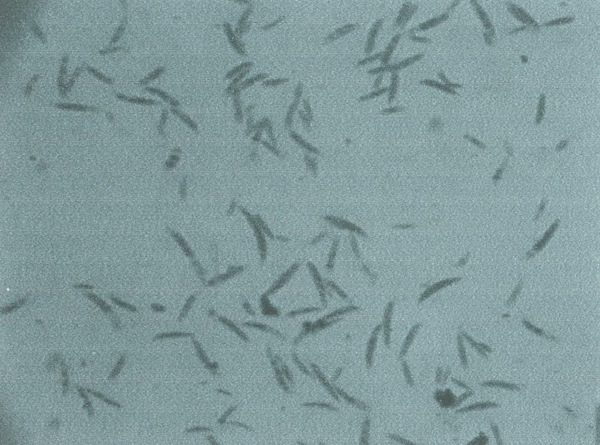
A. T2 Nuron Biosafe @ 1% Certain degree of microcondial population was oberved

A. T3 Nuron Biosafe @ 3%